Raw Water Quality Indicators Full Analysis: TDS, Conductivity, Hardness, COD, BOD
When planning an industrial water treatment project, the raw water analysis report is the first and most critical reference. All equipment design, including RO, UF, EDI and wastewater treatment systems, depends on raw water quality data. Many customers are confused about the meaning of TDS, conductivity, hardness, COD and BOD. This article will explain these five key indicators simply and clearly.
1. TDS (Total Dissolved Solids)
TDS means Total Dissolved Solids. It measures the total mass of dissolved inorganic salts and trace organic substances in water. The unit is ppm or mg/L.
TDS mainly includes calcium ions, magnesium ions, sodium ions, chloride, sulfate and other dissolved ions. High TDS means high salt content in raw water, which directly determines the desalination load of reverse osmosis equipment.
- Low TDS: Tap water or well water, single-stage RO is sufficient with standard RO membranes.
- High TDS: Brackish water, select special brackish water RO membranes according to the actual TDS value. Double-stage RO is only adopted when higher water purity is required.
Note: TDS only reflects total dissolved solids, it cannot tell you the type of individual ions.
2. Electrical Conductivity
Electrical conductivity (EC, unit: μS/cm) represents the ability of water to conduct electric current. The more ions dissolved in water, the higher the conductivity.
Conductivity has a positive correlation with TDS. Conductivity is a real-time monitoring index widely used in RO and EDI ultra-pure water systems. After RO treatment, conductivity drops significantly; EDI can further reduce ion content to obtain ultra-pure water with high resistivity.
Resistivity is the reciprocal of conductivity, commonly used for ultrapure water.
3. Water Hardness
Water hardness mainly refers to the concentration of calcium and magnesium ions in raw water, usually calculated as CaCO₃ (mg/L).
Calcium and magnesium ions are easy to precipitate and form scale on RO membrane, heat exchanger and pipeline. High hardness raw water must be equipped with softener or scale inhibitor dosing system. If hardness is ignored, RO membrane will be fouled quickly and shorten service life.
- Soft water: Hardness < 50 mg/L
- Hard water: Hardness >150 mg/L
4. COD (Chemical Oxygen Demand)
COD stands for Chemical Oxygen Demand. It measures the oxygen consumption when strong oxidant oxidizes organic and reducing pollutants in water, unit mg/L.
COD reflects the total organic pollution level of raw water. High COD may cause organic fouling on RO membrane. For raw water with high COD, pretreatment such as activated carbon filtration or oxidation needs to be added.
5. BOD (Biochemical Oxygen Demand, BOD5)
BOD5 is Biochemical Oxygen Demand for 5 days. It refers to the oxygen consumed by microorganisms to biodegrade organic pollutants under constant temperature.
BOD represents biodegradable organic matter. It is widely used in wastewater treatment design. The ratio of BOD/COD judges whether wastewater is suitable for biochemical treatment.
Summary: How these indicators guide your water treatment solution
- TDS & Conductivity: Confirm salt content, select suitable RO membrane type, single-stage / two-stage RO as required
- Hardness: Decide whether water softener is required to prevent scaling
- COD & BOD: Evaluate organic pollution, configure corresponding pretreatment or biochemical process
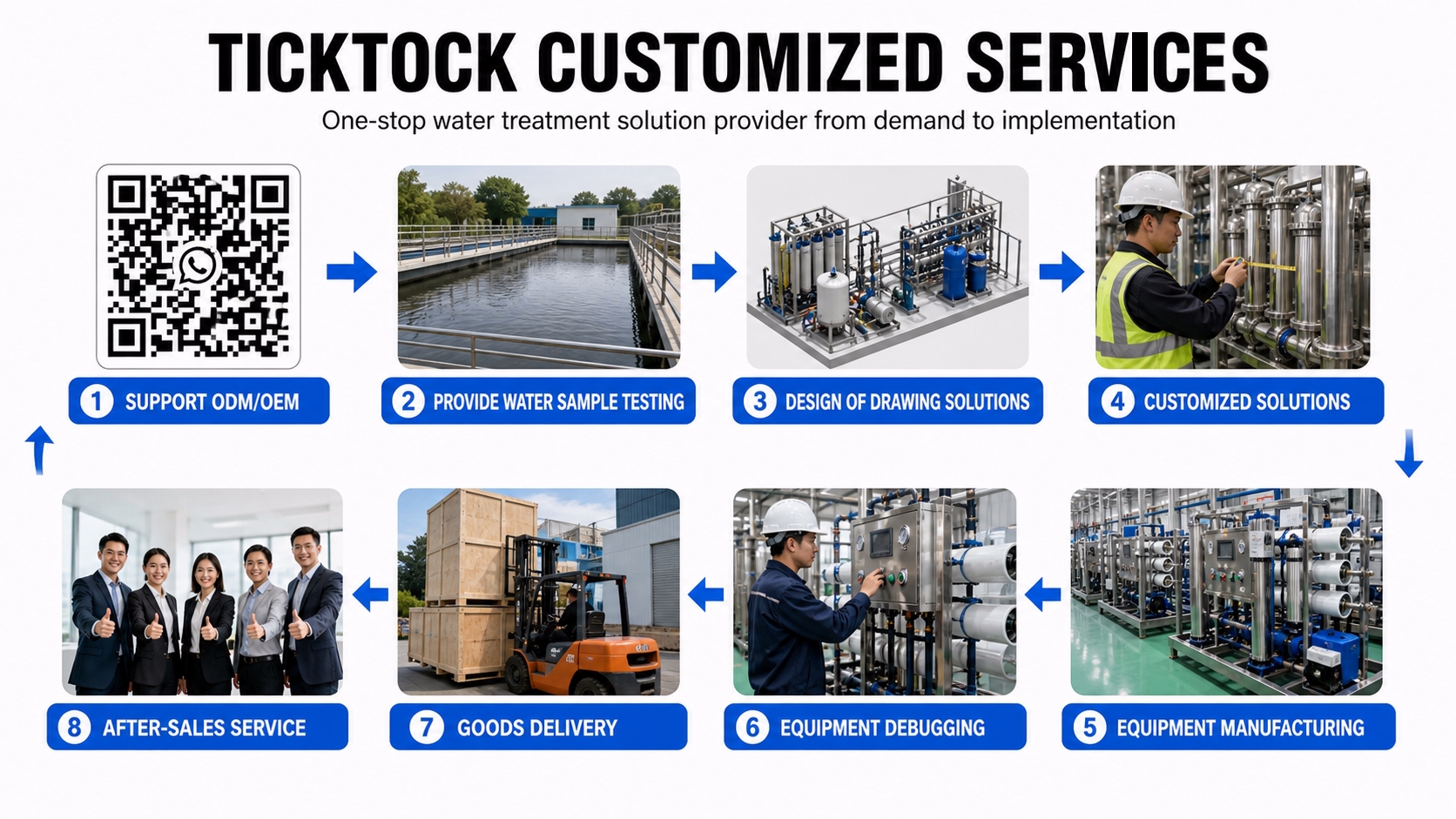
Before quoting water treatment equipment, we always ask customers to provide raw water quality report. Accurate raw water data helps us customize stable, cost-effective RO, UF and EDI systems.
If you have raw water test data, send it to our team. We can design a tailored industrial water purification solution for you.
FAQ
Q1: What is the difference between TDS and conductivity?
A: TDS is the total mass of dissolved solids in water (mg/L or ppm). Conductivity measures the water’s ability to conduct electricity (μS/cm). They are positively correlated, but conductivity is a real-time reading while TDS represents mass concentration.
Q2: Why is water hardness important for RO systems?
A: High hardness contains plenty of calcium and magnesium ions. These ions will precipitate and form scale on RO membranes, blocking membrane pores and shortening membrane service life. Softener or antiscalant dosing is needed for hard raw water.
Q3: What is the difference between COD and BOD?
A: COD measures all oxidizable substances (organic & reducing inorganic matter) by chemical oxidation. BOD5 only counts organics that can be decomposed by microbes. BOD/COD ratio tells us if wastewater can be treated by biological process.
Q4: Do I need to test all five indicators before buying a water treatment plant?
A: Yes. Raw water report with TDS, conductivity, hardness, COD and BOD is the foundation for us to design, select RO membrane type and configure UF or EDI equipment. Without these data, the water treatment solution may not match your site condition.
Q5: Can low COD raw water avoid activated carbon pretreatment?
A: It depends. If COD is very low and no odor, color or residual chlorine, activated carbon filter may not be required. Our engineers will evaluate the full water report to confirm the pretreatment configuration.