What is TDS?
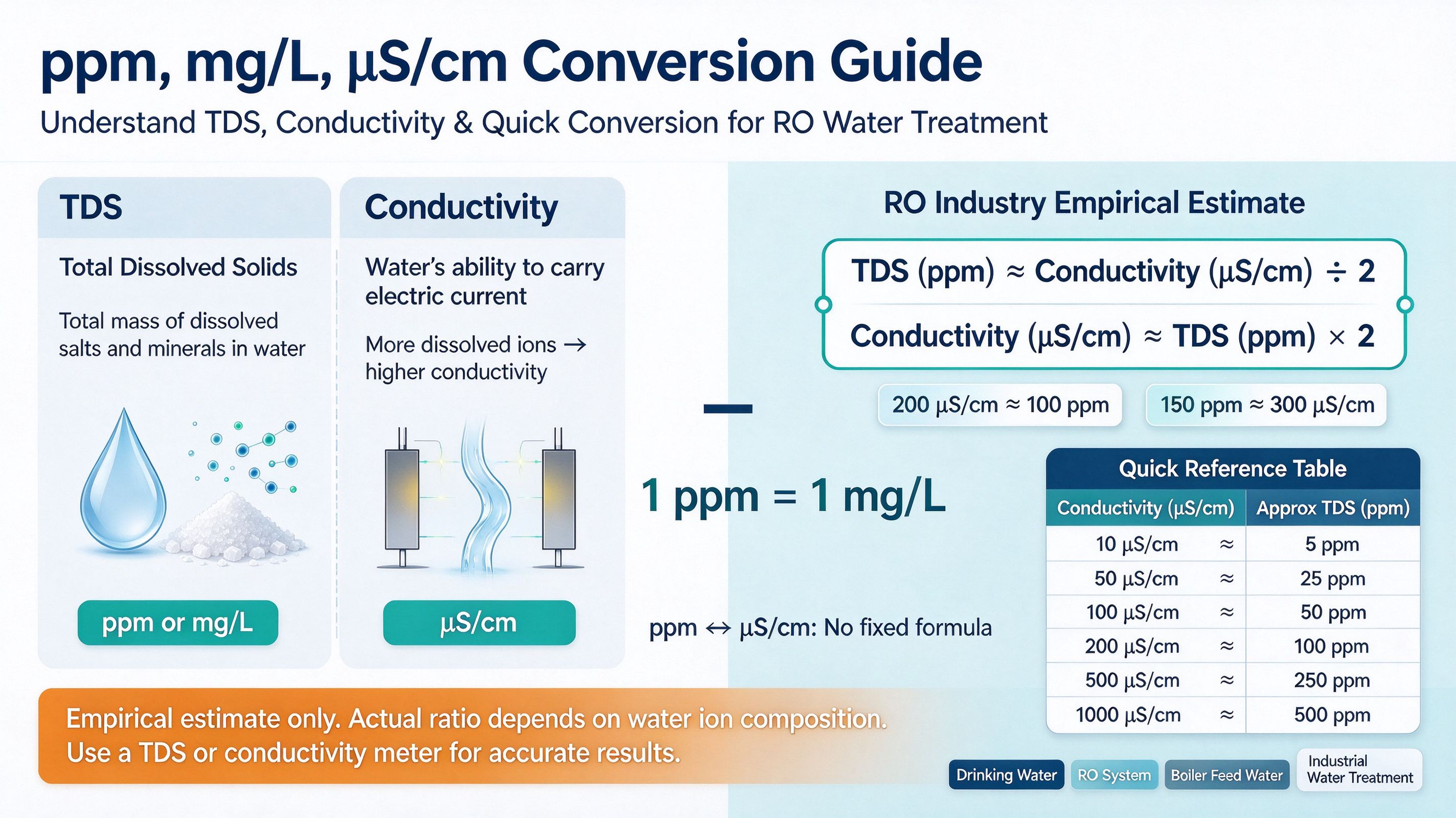
TDS stands for Total Dissolved Solids. It refers to the total mass of all inorganic and organic dissolved substances in water, including salts, minerals and dissolved ions. TDS is measured in ppm or mg/L. It tells you how much dissolved solids are present in your water.
What is Conductivity?
Conductivity (unit: μS/cm, microSiemens per centimeter) is the ability of water to conduct electric current. Pure water hardly conducts electricity. The more dissolved ions (salts) in the water, the higher the conductivity value. Conductivity is a direct reading you get from conductivity meters, widely used to monitor RO product water quality.
Important Core Note: TDS (ppm/mg/L) = mass of dissolved solids Conductivity (μS/cm) = electrical carrying capacity of ions ppm and mg/L can be directly converted. There is NO fixed mathematical constant for ppm ↔ μS/cm. The conversion ratio changes with different ion types in the water.
1. ppm vs mg/L
For dilute water solutions (water density ≈ 1 kg/L): 1 ppm = 1 mg/L Example: 180 ppm TDS = 180 mg/L TDS
This rule applies to most water treatment scenarios: tap water, underground water, brackish water and RO purified water.
2. TDS (ppm/mg/L) ↔ Conductivity (μS/cm)
This is the most common conversion requested by our RO system customers. For natural water and sodium chloride-based saline water (the empirical factor widely adopted in the RO industry):
- TDS (ppm) ≈ Conductivity (μS/cm) ÷ 2
- Conductivity (μS/cm) ≈ TDS (ppm) × 2
✅ Example: Conductivity = 200 μS/cm → Approx TDS ≈ 100 ppm TDS = 150 ppm → Approx Conductivity ≈ 300 μS/cm
⚠️ Critical Reminder: This is only an empirical estimate!
- Sodium chloride solution: factor ≈ 0.5
- Hard water with calcium bicarbonate: factor ≈ 0.55 ~ 0.7
- High-sulfate water: the factor will be higher For accurate results, test on-site with conductivity meters or TDS meters. Do not use this formula for precise calculation.
Quick Reference Table
| Conductivity (μS/cm) | Approx TDS (ppm / mg/L, NaCl basis) |
|---|---|
| 10 | 5 |
| 50 | 25 |
| 100 | 50 |
| 200 | 100 |
| 500 | 250 |
| 1000 | 500 |
| 2000 | 1000 |
| 5000 | 2500 |
| 10000 | 5000 |
FAQ
Q1: What is the difference between TDS and conductivity? A: TDS shows the total weight of dissolved solids. Conductivity reflects how well the water can conduct electricity. Two water samples with identical TDS may have different conductivity if they contain different ions.
Q2: Can I calculate conductivity directly from ppm? A: Not precisely. The factor 0.5 is used for quotation and preliminary evaluation for RO projects. The actual ratio depends on the ion composition of raw water.
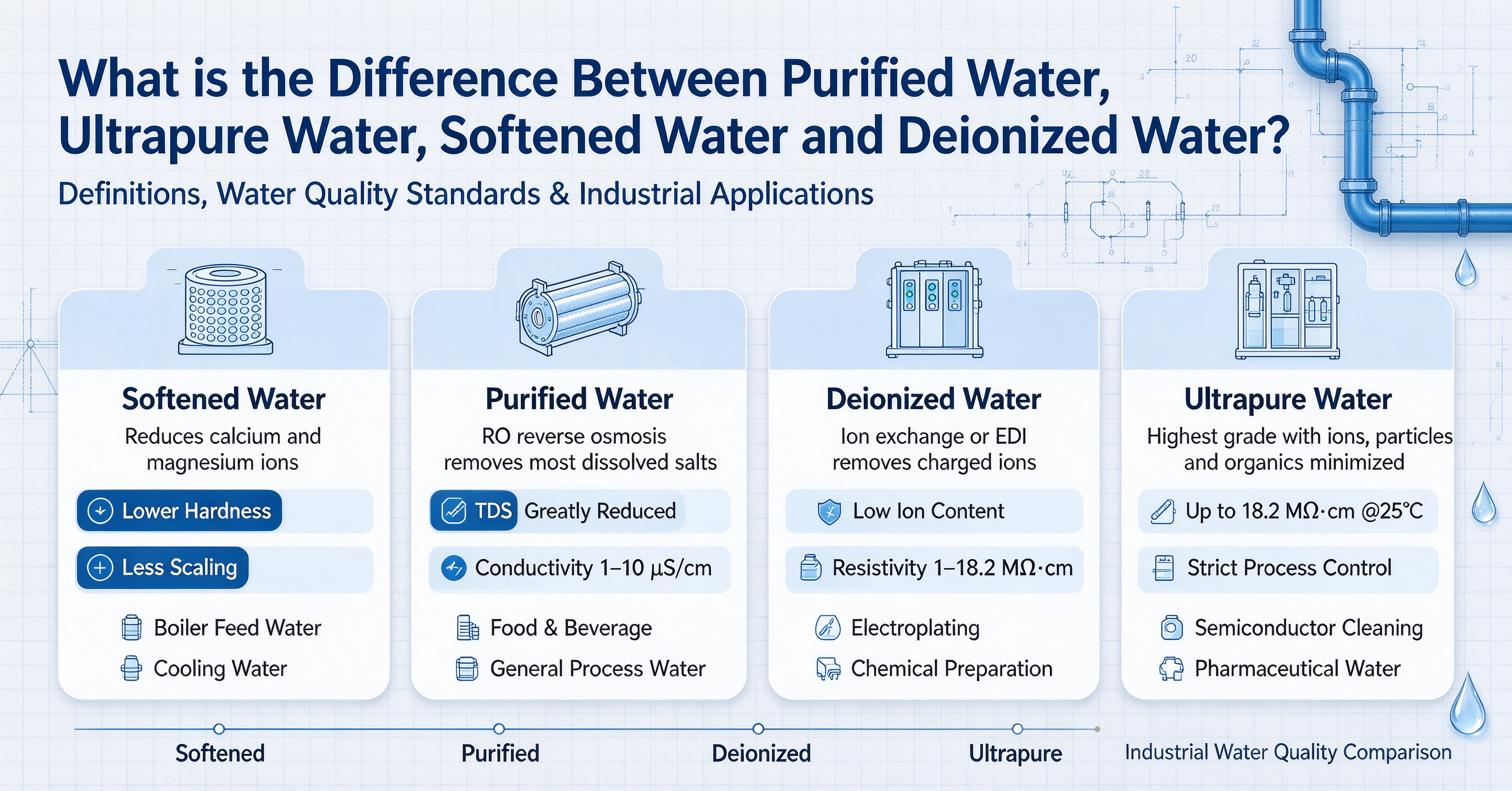
Q3: What conductivity standard for double-stage RO pure water? A: For double stage RO systems, the outlet conductivity is generally below 10 μS/cm, corresponding to TDS below 5 ppm.
Q4: Is TDS the same as salinity? A: No. Salinity mainly refers to sodium chloride content, while TDS covers all dissolved substances.